
August Market Pulse - The Market Has Been Waiting. Have You?
- Sage Capital
- 7 days ago
- 7 min read

“The most important thing is to understand where we are in the cycle.” — Howard Marks
For the last couple of years, Indian equity investors have had to be unusually patient.
The Nifty 50 made its previous high in September 2024. Since then, we have had geopolitical uncertainty, concerns around global growth, foreign investor selling and, more recently, the West Asia conflict and its impact on crude oil.
The market has recovered from some of these shocks, only to run into another one.
And yet, if you look at the Nifty today, the interesting thing is that we haven’t really gone very far.
That has understandably frustrated investors.
We have had quite a few conversations with clients who ask us the same question in different ways:
“If I had simply kept my money in a fixed-income instrument over the last two years, wouldn’t I have been better off?”
It is a fair question.
But there is another way of looking at what has happened.
The market has spent the last two years digesting the earnings growth of Corporate India.
And that could turn out to be important.
The market hasn’t moved much. Earnings have.
One of the charts in the latest AssetPlus report caught our attention.
Over the last five years, Sensex earnings have grown at around 13.9% CAGR, while Sensex TRI returns have been around 9.1% CAGR.
So while investors have been disappointed with market returns, the underlying companies have continued to grow their earnings.
This is an important distinction.
Over shorter periods, stock prices can do almost anything. Over longer periods, however, earnings tend to have a much greater influence on returns.
We have seen this many times before.
There are periods when markets run ahead of earnings and valuations become stretched. There are also periods when earnings continue to grow while prices don’t.
The latter is what appears to have happened over the last few years.
And when that happens for long enough, valuations have a chance to normalise without requiring a major collapse in prices.
That is broadly where we find ourselves today.

Source: BSE, Ace MF, WhiteOak MF, AssetPlus Research. Data as of 30-Jun-2026.
This has been more of a time correction than a market crash
There is another interesting observation in the latest DSP report.
The Nifty has now spent more than 103 trading days below its 200-day moving average.
That puts the current phase among the longer periods of consolidation seen in the history of the index.
But this hasn’t been a conventional bear market.
The Nifty has not even fallen 20% from its September 2024 peak.
Instead, we have seen a long period where prices have gone sideways while earnings have gradually improved.
DSP refers to this as a “time correction.”
I think that’s a useful way of looking at the current market.
Sometimes a correction happens through prices falling sharply.
Sometimes it happens through prices simply not moving for a long time.
The second one is considerably less dramatic, but it can be equally important for long-term returns.

Source: NSE, DSP. Data as of July 2026.
Are valuations attractive?
This is where we need to be a little nuanced.
We wouldn’t describe Indian equities as cheap.
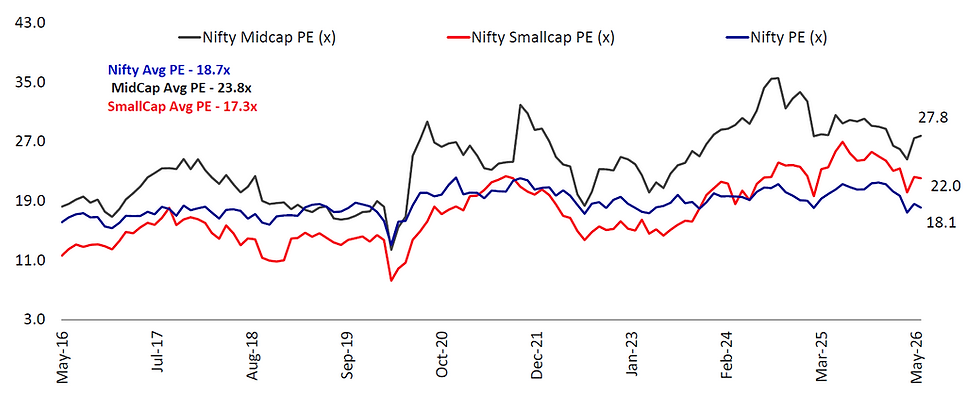
At around 20.5x earnings, the Nifty is certainly not trading at bargain-basement valuations.
But the valuation picture is much more comfortable than it was during the expensive phase of the previous cycle.
DSP’s latest data shows the Nifty’s price-to-book ratio at around 2.95x, below 3x for the first time since December 2020.
AssetPlus’ broader Equity Valuation Signal also puts Indian equities in its “Attractive” zone, with a score of 49 out of 100 as of June 2026.
The historical numbers are particularly interesting.
When the valuation signal has been in the 30–50 range, the average five-year forward Nifty 50
TRI return has been around 15%. In 90% of those observations, returns over the following five years were above 12% annually.
Of course, we shouldn’t interpret that as a forecast.
Markets don’t work that neatly.
But it does tell us that the starting point today is considerably more reasonable than it was
when investors were willing to pay almost any price for growth.

Source: AssetPlus Research, BSE, Ace MF, Investing.com, MoSPI. Data through 30-Jun-2026.
There is one area where we would remain cautious
The valuation comfort isn’t uniform across the market.
This is particularly important for investors who have been adding aggressively to small and mid-caps over the last few years.
DSP’s latest analysis puts the median P/E of the small and mid-cap universe at around 38x, against a long-term average of approximately 20x.
That is still a significant premium.
Large caps, in comparison, have become more attractive. They offer better ROEs in many cases and, importantly, valuations that are much closer to historical norms.
This doesn’t mean we don’t like mid and small caps.
It simply means that we think investors need to be more selective.
The next phase of the market may not reward simply owning everything.
Quality, earnings visibility and the price you pay for growth will matter.
The part we are watching most closely: earnings
Ultimately, the market needs earnings to move higher.
And this is where the outlook is becoming more interesting.
AssetPlus expects earnings growth to recover to around 15% over FY26–FY28.
There are also some encouraging signs in the broader economy. Bank loan growth has started picking up, gross fixed capital formation remains healthy and corporate ROEs have recovered from their earlier lows.
The report categorises us as being in the mid-phase of the earnings cycle.
That is important because the last few years of the Indian market were driven to a large extent by valuation expansion.
It would be difficult to repeat that indefinitely.
The next leg of returns needs to come from earnings.
And if earnings do recover as expected, today’s more reasonable valuations give investors a better starting point.
Foreign investors have been selling. And India has absorbed it.
FII selling has been one of the biggest stories of the Indian market over the last few years.
AssetPlus estimates that FIIs have sold around ₹3.6 lakh crore since January 2022.
But there is another number that is perhaps more important.
Over the same period, DIIs have invested approximately ₹22.3 lakh crore.
This is one of the biggest structural changes in the Indian market.
Domestic savings have become a genuine source of market liquidity.
It doesn’t mean FII selling no longer matters. It does.
But it does mean that India is less dependent on foreign capital than it was in the past.
And if global investors eventually become more constructive on India, there is a possibility that
we could see both sources of liquidity supporting equities rather than just one.
So, what do we make of all this?
Our view is fairly simple.
We don’t think investors should expect the market to suddenly deliver extraordinary returns every year.
In fact, DSP’s analysis makes a good point here: with broad revenue growth likely to remain around the 10–12% range and margins already close to cyclical highs, return expectations should remain sensible.
But we also don’t think the last two years should be extrapolated into the next three.
The market has already gone through a meaningful period of consolidation.
Earnings have continued to grow.
Valuations have come down.
Domestic flows remain strong.
And earnings expectations are beginning to improve.
That makes us constructive on Indian equities over a three-to-five-year horizon.
What should investors do?
For us, the answer isn’t to suddenly become aggressive.
It is to remain invested and use this phase sensibly.
If you are already investing through SIPs, there is little reason to stop them simply because the market has been frustrating.
If you have a significant amount of money sitting on the sidelines, this is a reasonable environment to start deploying it rather than waiting indefinitely for the perfect correction.
And if your portfolio has become heavily tilted towards small and mid-caps because of their
strong performance in previous years, this may be a good time to review that allocation.
Most importantly, look at your portfolio through the lens of your goals.
A market view is useful.
But the right asset allocation is far more important.
The market doesn’t need to look exciting for the opportunity to be attractive
This is probably the biggest takeaway we have from the current cycle.
Investors often want to buy when the market is doing well and the outlook feels clear.
Unfortunately, that is usually when valuations are least comfortable.
Today, we have almost the opposite situation.
The market has been frustrating.
Sentiment isn’t euphoric.
There are still plenty of things to worry about.
But valuations have become more reasonable and earnings are expected to improve.
That is not a guarantee of strong returns.
It is simply a better starting point.
And for a long-term investor, starting point matters.
One final thought
The last two years may eventually prove to be less about a market that went nowhere and more about a market that allowed earnings to catch up with prices.
We don’t know what the next six months will look like.
There could be another correction. There could be another geopolitical shock. Markets could remain sideways for longer than we expect.
That’s perfectly possible.
But investing isn’t about getting every six-month call right.
It is about putting yourself in a position where, over the next three to five years, the odds are in your favour.
We believe those odds are looking better today than they did two years ago.
And perhaps that is the more important story behind this long, frustrating consolidation.
Want to know what this means for your portfolio?
A market view tells you what we think.
Your asset allocation tells us how you should act on it.
If you haven’t reviewed your portfolio recently, our Risk Profiler can help determine an appropriate equity allocation based on your goals, time horizon and risk profile.
Know Your Asset Allocation → https://www.sagecapital.in/risk-profiler
Have money waiting on the sidelines?
If you’re unsure whether to invest now, stagger your investments, or simply continue with your existing SIPs, speak to us.
We’ll help you decide how to deploy your money based on your portfolio and goals rather than trying to predict the next market move.
Talk to Sage Capital → https://calendly.com/sage-capital/poreview
Thank you for being part of the Sage Capital community.
Warm Regards,
Nikhil Gupta
Helping investors build wealth with clarity, discipline, and patience.
AMFI Registered MFD
ARN-177251


Comments