
July Market Pulse - The Market Has Started Recovering. Do You Trust It Yet?

"The intelligent investor is a realist who sells to optimists and buys from pessimists." - Benjamin Graham
Last month, we wrote about why the point of maximum uncertainty is often the point of maximum return.
At that time, headlines were dominated by the escalating conflict in West Asia, rising crude oil prices, and fears of another prolonged correction in equity markets. Many investors questioned whether equities were still worth the patience.
Fast forward just one month.
Markets have quietly recovered.
Not because uncertainty has disappeared.
But because markets rarely wait for certainty.
That may be the biggest lesson investors can take away from the past month.
Markets Have Started Doing What History Suggested
One month ago, investor sentiment was dominated by fear.
Today, while uncertainty still persists in West Asia and geopolitical headlines continue to fluctuate almost daily, Indian equities have continued to move higher.
This often surprises investors.
“Why are markets rising when the news still looks negative?”
The answer is simple.
Markets don’t react to today’s headlines—they react to tomorrow’s expectations.
When everyone expects bad news, even slightly better outcomes can move markets significantly.
That is exactly what we are witnessing today.
The Headlines Haven’t Changed Much...
The world still faces several uncertainties.
The conflict in West Asia continues.
Oil prices remain volatile.
Global trade and tariff concerns haven’t completely disappeared.
Foreign Institutional Investors (FIIs) continue to remain cautious.
Yet despite all of this, Indian markets have remained remarkably resilient.
Why?
Because investors are beginning to differentiate between temporary uncertainty and long-term fundamentals.
The market is slowly shifting its focus away from geopolitical headlines and back towards what ultimately drives equity returns—earnings, economic growth, and valuations.
India Continues to Stand Out
Consumption continues to improve.
Government capital expenditure remains supportive.
Corporate balance sheets are healthier than they have been in years.
Most importantly, domestic investors continue to demonstrate remarkable confidence.
Systematic Investment Plans (SIPs) continue to see robust monthly inflows, while Domestic Institutional Investors have absorbed a large part of the selling by foreign investors.
A decade ago, prolonged FII selling would have significantly destabilised Indian markets.
Today, that is no longer the case.
India’s investor base has matured.
And that’s an important structural change.
Valuations Are Finally Looking Comfortable Again
One year ago, one of the biggest concerns among investors was simple:
“Markets have become too expensive.”
That concern has eased considerably.
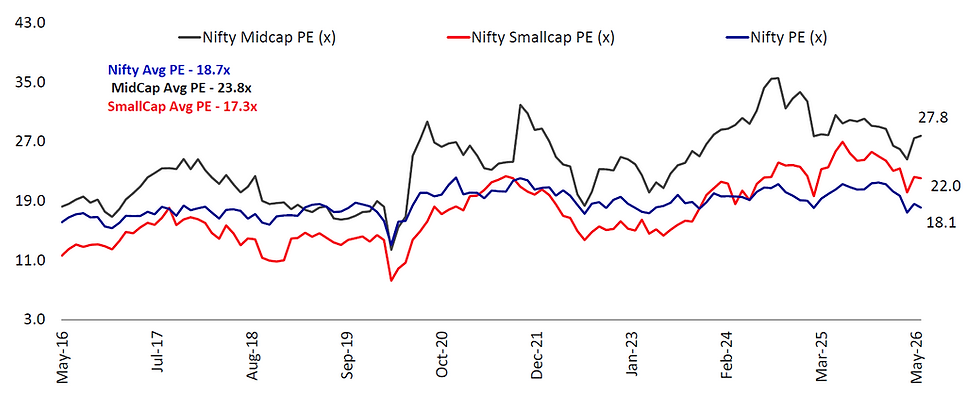
Following the correction over the past 18 months, valuation multiples have moderated meaningfully, especially in large-cap companies.
As highlighted in the chart below, the Nifty 50 Price-to-Earnings ratio has moved much closer to its long-term average.

This matters because long-term returns are not determined by today’s headlines.
They are largely determined by the price investors pay today for future earnings.
Today, investors are paying significantly more reasonable prices than they were a year ago.
That improves the probability of generating better long-term returns.
Every Crisis Feels Different. Every Recovery Looks Similar.
Perhaps the most interesting observation isn’t what happened over the last month.
It’s what has happened after similar periods throughout history.
Since 2001, Indian markets have experienced multiple phases where returns remained muted for nearly two years.
Each period had its own reason.
The Dot-com crash.
The Global Financial Crisis.
The Eurozone debt crisis.
Demonetisation.
COVID-19.
Each one felt unique.
Each one convinced investors that “this time is different.”
Yet the outcome was remarkably similar.
Once uncertainty began reducing, markets recovered far more quickly than most investors expected.
In fact, history shows that prolonged periods of muted returns have often been followed by some of the strongest three-year returns for patient investors.

Notice something interesting.
The opportunity wasn’t visible while the crisis was unfolding.
It only became obvious in hindsight.
That is exactly why investing during uncertain times feels uncomfortable.
The Biggest Risk Today Isn’t The Market
It Is Investor Behaviour.
After nearly two years of waiting for meaningful returns, many investors are beginning to ask:
“Should I wait for another correction before investing?”
History suggests that waiting for complete clarity has rarely been a successful investment strategy.
Markets typically recover before investor confidence does.
By the time headlines improve and optimism returns, valuations often move higher and a significant part of the opportunity has already passed.
As Sir John Templeton famously said,
“Bull markets are born on pessimism, grow on skepticism, mature on optimism, and die on euphoria.”
Today, we certainly aren’t witnessing euphoria.
If anything, investors remain cautious.
Historically, that has been a healthier backdrop for long-term investing than periods of excessive optimism.
So, What Should Investors Do?
Rather than trying to predict the next geopolitical headline or the next market correction, investors should focus on what they can control.
✔ Continue your SIPs.
✔ Review your asset allocation.
✔ Invest systematically.
✔ Focus on businesses with strong earnings visibility and quality balance sheets.
Because wealth creation has rarely been about predicting markets.
It has almost always been about staying invested when others found it difficult to do so.
Final Thoughts
No one knows where markets will be over the next month.
Or even the next quarter.
But history provides enough evidence to be optimistic about what patient investors can achieve over the next three to five years.
Today we have:
Reasonable large-cap valuations
Improving earnings expectations
Strong domestic liquidity
A resilient Indian economy
And investor sentiment that is still cautious—not euphoric
That combination has historically laid the foundation for attractive long-term returns.
The market has already started recovering.
The real question is:
Will investors trust it before everyone else does?
Enjoyed this month’s Market Pulse?
If this article helped you look at today’s markets from a different perspective, consider sharing it with a fellow investor.
And if you’d like to understand whether your current portfolio is positioned appropriately for the next phase of the market, we’d be happy to have a conversation.
Know your ideal asset allocation → https://www.sagecapital.in/risk-profiler
Thank you for being part of the Sage Capital community.
Warm Regards,
Nikhil Gupta
Helping investors build wealth with clarity, discipline, and patience.


Comments